
Tube fittings
Tube fittings and instrumentation
Double and single ferrule fittings, connectors, unions, swivels, high-pressure adaptors, thermowells and condensate pots for instrument and hydraulic lines.
Range
Tube fitting ranges
 Double ferrule fittingsTwo-ferrule compression tube fittings in SS 316, SS 304, brass and special alloys for…
 Single ferrule fittingsSingle ferrule (bite-type) fittings to DIN 2353 / ISO 8434-1 for hydraulic and…
 SS tube fittingsSS 316 and SS 304 compression tube fittings
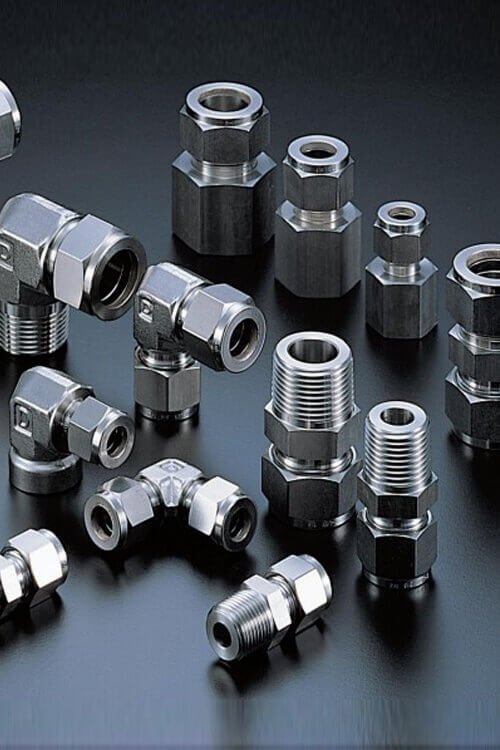 SS ferrule fittingsSS ferrule fittings for instrument and process tubing
 Instrumentation tube fittingsInstrumentation tube fittings for impulse, sample and control lines
 Instrument valves & fittingsNeedle valves, soft-seal plug valves and high-pressure adapters with tube or threaded…
 Metric tube fittingsMetric tube fittings for mm-sized tubing
 ConnectorsMale, female and bulkhead connectors that join tubing to threaded ports
 Brass tube fittingsBrass compression and flare fittings for water, air, gas and oil lines
 Swivel fittingsHigh-pressure swivel fittings, swivel elbows and swivel tube connectors that let…
 High pressure fittingsHigh-pressure adaptors, unions and tube fittings for 6,000 to 20,000 psi service,…
 ThermowellsThreaded, flanged and weld-in thermowells that protect temperature sensors in process…
 Condensate potsCondensate pots for steam flow measurement and air headers for instrument air, in…
 Push-in & hose fittingsPush-in tube fittings for pneumatic lines, beaded hose fittings and…
Selection
Choosing the right tube fitting
Most instrument lines use two-ferrule (double ferrule) compression fittings in SS 316. They grip the tube firmly, seal on the tube and the body, and stand up to vibration and temperature cycling. Hydraulic lines built to European designs usually use single ferrule (bite-type) fittings to DIN 2353 / ISO 8434-1, while JIC 37° flare fittings are common on equipment built to American designs.
Start with the tube: its outside diameter, wall thickness and material decide the fitting size and the pressure rating. Then choose the end connection at the other side (NPT, BSPT, BSPP or metric thread, another tube end, or a weld end), the material for the medium and the environment, and any special needs such as bulkhead mounting or a swivel.
Reference
Common tube fitting types
| Type | What it does |
|---|---|
| Male connector | Joins a tube to a female threaded port |
| Female connector | Joins a tube to a male threaded pipe or fitting |
| Union | Joins two tubes of the same size |
| Reducing union | Joins two tubes of different sizes |
| Bulkhead union / connector | Passes a tube through a panel or wall |
| Elbow, tee, cross | Changes direction or creates branches |
| Port connector / adapter | Converts between tube ends and thread types |
| Plug and cap | Closes a fitting end or a tube end |
FAQ
Frequently asked questions
What is the difference between single ferrule and double ferrule fittings?
Double ferrule (two-ferrule) fittings split the work between a front ferrule, which seals against the fitting body and the tube, and a back ferrule, which drives the front ferrule and grips the tube. That suits instrument lines with vibration and temperature cycling. Single ferrule (bite-type) fittings use one ferrule that bites into the tube; they are the usual choice for hydraulic lines built to DIN 2353 / ISO 8434-1.
Can I mix nuts, ferrules and bodies from different manufacturers?
We advise against it. Nuts, ferrules and bodies are designed and tested as a set, so mixing parts makes the pressure rating and leak-tightness unpredictable. Order complete fittings, and buy spare nuts and ferrules from the same series.
What tube should I use with stainless steel tube fittings?
Use fully annealed seamless or welded-and-drawn stainless steel tube, for example to ASTM A269 or A213, that is softer than the fitting and within the OD tolerance the fitting is made for. Choose the wall thickness for the working pressure. Send us the tube specification and we will confirm the match.
Which thread do I need: NPT, BSPT or BSPP?
NPT (ASME B1.20.1) and BSPT (ISO 7-1) are both tapered and seal on the thread with a sealant, but their thread forms differ (60° and 55°). BSPP (ISO 228-1) is parallel and seals with a bonded washer or O-ring. They are not interchangeable, so check the port you are connecting to.
What pressure rating do the fittings have?
The rating depends on the tube OD and wall thickness, the material and the temperature, and the tube is usually the limiting part. Tell us the tube size and the working conditions and we will quote fittings rated for the duty.
Next step
Tell us what you need
Part number, size, material or a full list: send it and get a clear quotation.